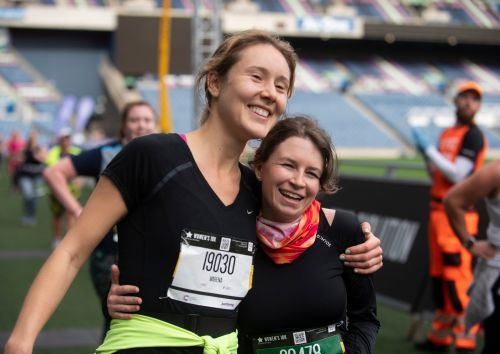
The Women’s 10K Edinburgh takes participants from the historic Lawnmarket through some of the capital’s most recognisable locations before delivering a grandstand finish inside Scottish Gas Murrayfield Stadium.
For runners, the event is a supportive and memorable journey past landmarks including the Scottish National Gallery, Princes Street Gardens, the Scottish Parliament, Holyrood Palace, Dynamic Earth and the Grassmarket. Behind that experience is a carefully coordinated operation involving road closures, baggage transport, medical coverage, volunteers, timing systems and two major event venues.
The Women’s 10K also follows the Men’s 10K Edinburgh on the same day. This adds an operational challenge that most participants never see: the team must reset and prepare the entire event for another field while parts of the first race are still being cleared.
Sharing a Course Across Two Races
Using one route for the Men’s and Women’s 10K events is efficient, but it does not mean simply repeating the same process. The operations team tracks when the Men’s field clears each section and when participants in the Women’s race begin arriving at the Lawnmarket. Start infrastructure must remain secure, toilets serviced where required and signage checked before the next race. Medical teams review incidents from the first event and confirm that sufficient resources are ready for another field. Hydration and finish supplies are counted and replenished. Volunteers may need breaks, new briefings or position changes. Those movements must happen without leaving critical parts of the course unsupported. Timing systems also need to be reset for a new participant database. The equipment may remain physically in the same place, but the technical team must ensure every Women’s 10K runner is recorded under the correct event. The timetable contains carefully calculated gaps. If the earlier race is delayed, the effect can spread through road closures, volunteer shifts, baggage schedules and stadium operations.
Months of Planning Before Race Day
The public sees the event for a few hours, but preparations begin months in advance. The course team reviews the route and considers whether roadworks, building projects or changes to public transport will affect delivery. A course used successfully in a previous year still needs to be inspected and approved again. Organisers work with the City of Edinburgh Council, transport operators, emergency services, Scottish Gas Murrayfield and other partners. Each organisation has different priorities and responsibilities. Traffic-management plans set out which roads will close, when barriers will be installed and how local access will be maintained. Bus operators need enough notice to plan diversions and brief drivers. The medical plan considers participant numbers, weather, course access and previous incident patterns. Volunteer coordinators determine how many people are required and where they will be positioned. Every temporary structure, radio, toilet, medal and bottle of water must be ordered and delivered at the right time.
Preparing the Historic Start
The Lawnmarket is a working historic street, not a permanent athletics venue. Transforming it into a start area requires careful use of limited space. Barriers, pens, timing mats, toilets, signage and baggage vehicles must fit around buildings, visitor routes and emergency access. Installations cannot damage the historic environment. The start team works during tightly controlled setup windows. Deliveries arriving late may be unable to reach their intended location once closures begin. Before runners arrive, timing technicians test the start mats and communication links. Course managers confirm that the route ahead is ready. Volunteers receive briefings explaining where to direct participants, how starting pens will operate and what to do when someone has lost a number or needs additional assistance. As the start time approaches, the team monitors crowd density. Participants are guided into pens based on predicted finishing times, helping runners find space once the race begins. Each pen is released in a controlled sequence. This reduces congestion and allows the timing system to register every runner accurately.
Baggage on the Move
Because the race starts in central Edinburgh and finishes at Murrayfield, runners cannot leave their belongings in one place. Baggage trucks are positioned near the start. Participants attach identifying tags before handing over their bags, which volunteers arrange into numbered groups. Loading order is important. It determines how efficiently the bags can be unloaded and displayed at the stadium. Vehicles must leave the Lawnmarket on schedule, following routes that avoid closures and the race itself. Drivers work from event-specific instructions rather than relying entirely on ordinary navigation. At Murrayfield, the bags are unloaded into clearly marked collection zones. The layout must allow tired runners to find their belongings without blocking finish exits or medical access. A bag without a tag or placed in the wrong section can be difficult to resolve. Baggage volunteers need patience, accurate records and a clear escalation process.
Course Management Through Edinburgh
The Women’s 10K passes through several environments, each with different operational risks. Princes Street Gardens contains public paths and sensitive green space. Holyrood combines tourist activity, major landmarks and an exposed park setting. The Grassmarket has narrow pavements, businesses and large numbers of pedestrians. Marshals at each location receive position-specific instructions. A volunteer in a park manages different issues from someone controlling a busy city-centre crossing. Barriers guide spectators and other pedestrians, but they cannot answer questions or respond to unexpected behaviour. Marshals provide the human communication that makes the traffic plan work. Course supervisors move between sectors, checking signs and responding when equipment has shifted or a position requires additional support. A small problem can have wider consequences. A damaged directional sign may confuse runners, while an unsecured crossing can allow a pedestrian onto the course. The course team remains active until the final participant and sweep operation have passed.
The Volunteers Who Shape the Experience
Women’s 10K participants include experienced competitors, charity fundraisers and people entering their first organised race. Volunteers help every group feel welcome. At the start, they answer questions and reassure nervous participants. Along the route, they provide directions and encouragement. At Murrayfield, they congratulate finishers and distribute medals. Their work is not limited to creating atmosphere. Volunteers observe the course and report problems. A marshal may notice a runner who appears unwell, a barrier that has moved or a member of the public entering a restricted area. Quick reporting allows race control to send the appropriate response. Briefings explain how to describe an incident clearly and when to request medical help. Volunteers are not expected to provide treatment beyond their training. Volunteer welfare is also part of the event plan. People may be stationed outdoors for hours in rain, wind or sunshine. They need suitable equipment, refreshments and clear instructions about when their position can close.
Medical Planning for a Diverse Field
A 10K may be shorter than a marathon, but it still requires comprehensive medical planning. Competitive runners may be operating close to their physical limit, while first-time participants may be less familiar with pacing, hydration and recovery. Medical resources are positioned according to course geography, expected runner density and access. Mobile responders support fixed treatment points. The Old Town, Holyrood Park and the approach to Murrayfield each present different access considerations. The plan identifies how responders can reach every section despite road closures. Race control tracks which medical resources remain available. If one team is committed to an incident, control knows what coverage is left elsewhere. At the finish, runners may become dizzy or unwell after stopping. Medical staff and trained volunteers watch participants as they leave the line. The aim is not only to react to emergencies but to recognise developing problems early and prevent them from becoming more serious.
Race Control Maintains the Overview
Race control is the operational centre connecting every part of the event. It receives reports from course managers, medical teams, traffic staff, timing technicians, transport coordinators and Murrayfield operations. The team tracks the leaders, main field and final participant. Those positions determine when roads can reopen and when volunteers can leave their posts. If a road barrier fails, a spectator enters the route or a medical incident affects runner flow, race control coordinates the response. Radio traffic must remain concise. Teams use agreed call signs and precise location references so incidents can be understood immediately. Race control also watches the schedule. Delays affect road restrictions, volunteer hours, public transport and the stadium finish. Important decisions and incidents are recorded, creating evidence for the post-event review.
Timing Thousands of Individual Journeys
Each runner wears a timing device linked to her event number. Mats at the start, intermediate points and finish record her progress. Timing equipment must be installed, protected from weather and tested before the race. Backup systems reduce the risk of losing results if a component fails. Because the Men’s event takes place earlier, technicians must ensure the Women’s 10K is configured as a separate race. Finish cameras provide another record when several participants cross together. After the event, unusual or missing results can be investigated using data from multiple sources. Timing is more than publishing finishing times. Intermediate information helps operations staff understand how the field is moving and when different sectors may clear.
The Murrayfield Stadium Finish
The grandstand finish is the emotional centre of the Women’s 10K Edinburgh. Delivering it requires the course to enter the stadium safely, pass through controlled internal areas and reach the timing line without conflict from spectators or venue activity. Temporary barriers separate participants from the crowd. Finish mats, cameras, signage and public-address systems are tested before the first runner arrives. Participants need enough space to slow down after crossing. Volunteers keep them moving towards medals, hydration and recovery areas. The finish funnel cannot become a meeting point. Spectators are directed towards a separate reunion area so families do not block arriving runners or emergency access. Baggage collection is positioned beyond the immediate finish flow. Medical teams have protected routes into the line and treatment areas. Only authorised people can enter operational zones, even when a family member can see a runner who has just finished.
Managing Roads and Public Transport
The event affects the Royal Mile, Holyrood, Grassmarket and roads leading towards Murrayfield. Traffic-management teams install barriers and diversion signs according to approved plans. Critical closure points are staffed throughout the race. Transport operators divert buses around the course. Drivers and passengers need accurate information about where services will stop. Edinburgh Trams provide an important connection between the city centre and Murrayfield. Large numbers of spectators may travel after the start, while runners and families use the system after finishing. Roads reopen sector by sector after the final participant, sweep team and clearance crew have passed. A gap in the field does not mean a road is ready for traffic. Signs, barriers and waste must be removed before normal access resumes.
The Work After the Final Finish
When the last runner crosses the line, participants begin celebrating. The operations team begins another phase of work. Timing data is checked, medical incidents documented and lost property recorded. Radios and volunteer equipment are returned. Contractors remove barriers, toilets, signs and technical installations. Baggage teams reconcile any unclaimed items. The Lawnmarket, course and stadium are inspected before being handed back to normal use. Managers then conduct a debrief. They review the combined Men’s and Women’s operation, including turnaround time, volunteer coverage, medical activity and finish congestion. Feedback from runners, volunteers, residents and transport partners helps identify improvements. The Women’s 10K Edinburgh succeeds because a large team creates the conditions for individual achievement. Participants may remember the Royal Mile, the encouragement through the city and the moment they entered Murrayfield. Behind those memories are people who installed the barriers, transported the baggage, stood at crossings, monitored the radios and stayed until the final piece of equipment was removed. Their work is the hidden foundation beneath every finish-line celebration.